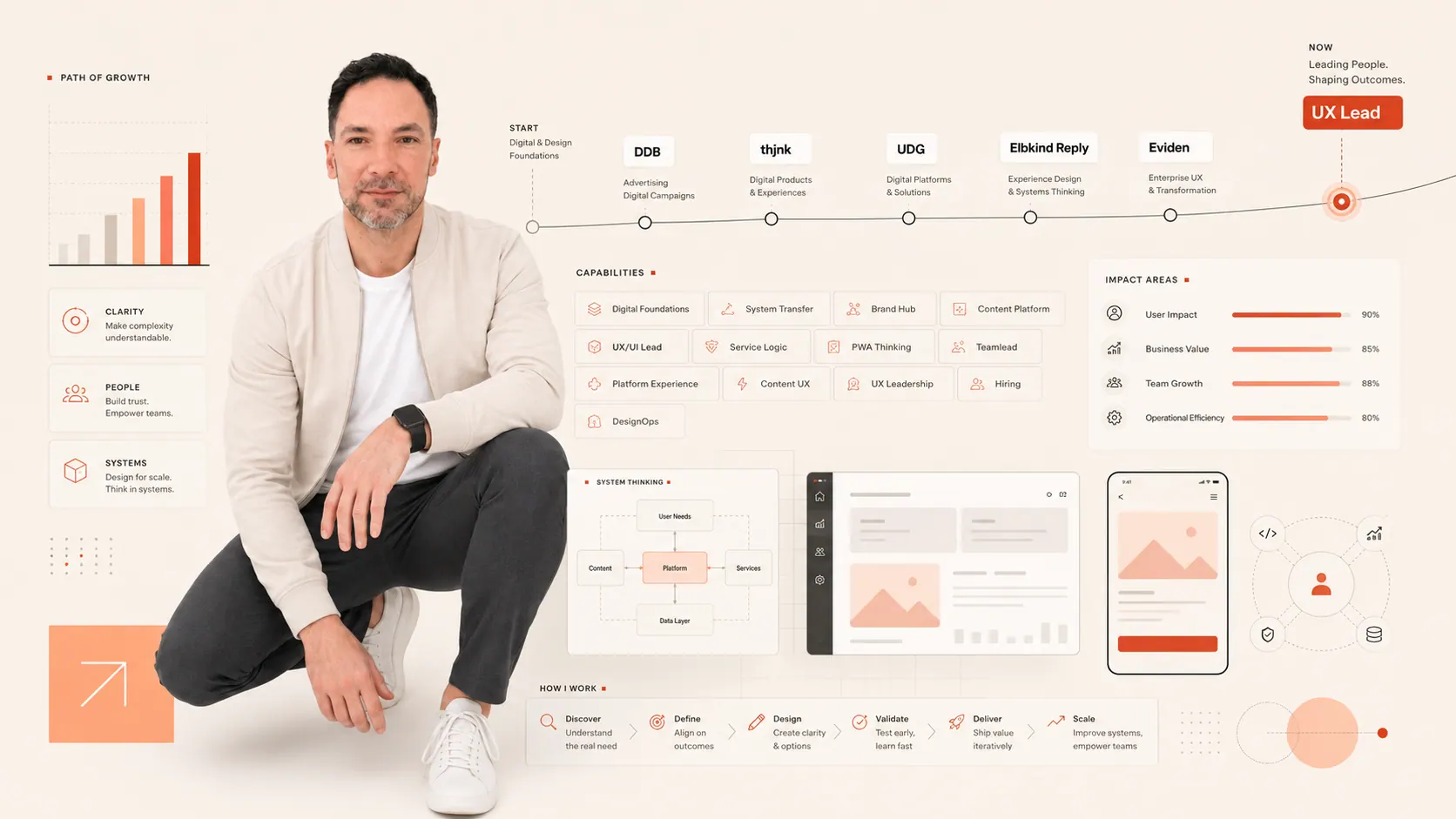
01 — The Context
A career is more interesting once you can see the throughline.
From DDB and Volkswagen through thjnk, UDG, and Elbkind to Atos: the products became more complex, the responsibility greater, and design increasingly a question of shared decisions.
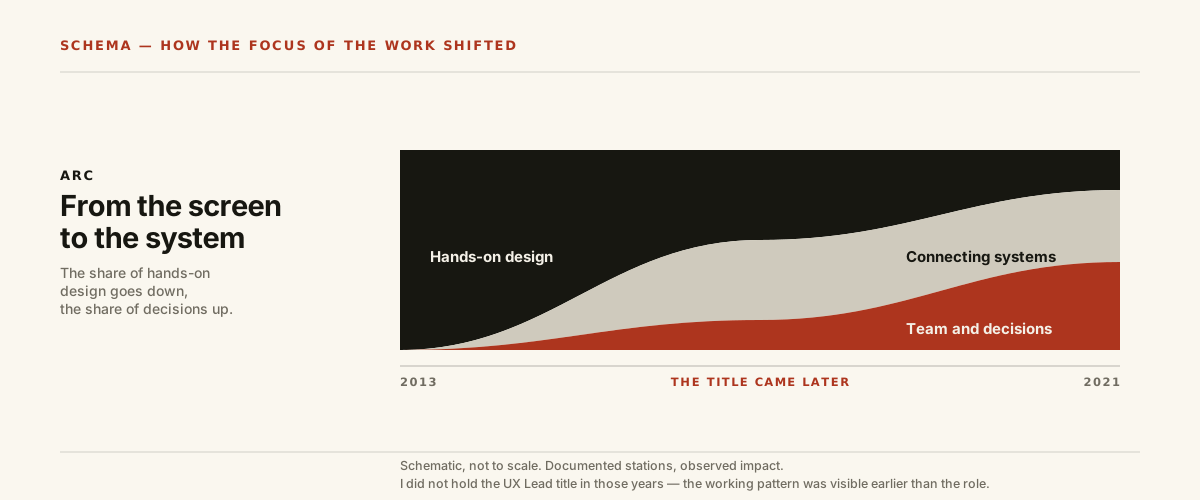
The development:First build strong interfaces. Then connect systems. Finally bring teams and stakeholders onto one direction.
The throughline:Not volume, but clarity. Not protecting my own design, but the quality of the shared decision.
02 — The Impact
More responsibility. Less need to do everything myself.
This case study is not a single project. It shows how visual execution turned into strategic UX leadership, and why I would rather strengthen systems and teams today than only deliver screens. Important for context: in those years I did not hold the title UX Lead. The title came later. The working pattern was visible earlier.
Much from these years is under NDA or simply no longer public. I am glad to talk concretely about individual roles, responsibilities, and decisions.
03 — The Approach
With every role the lever changed.
DDB · Volkswagen
Learned to think in systems: brand quality has to work consistently across many touchpoints.
thjnk · UDG · Elbkind
Connected platforms, early UX leadership, and team responsibility.
Atos · Eviden
Owned enterprise products and UX quality in complex delivery. I co-built the Experience Design area and carried the hiring together with the Head of Design.
“At some point the most important screen is no longer the one you design yourself. It is the one the team designs without you.”The shift from design to leadership
04 — Key Learnings
What stayed from this work.
Leadership without a feel for execution turns abstract fast. I want to hold both together.
A strong team needs direction and trust, not constant correction loops.